Online Reputation Management
Brand Reputation Management: 13 Best Practices & Top Tools

Studies show that over 90% of consumers read online reviews before making a purchase decision, making brand perception a direct factor in revenue. Online perception directly influences buying decisions. Even a small amount of negative content can affect how customers view your brand reputation, especially when they compare options in search results and on third-party platforms.
For most businesses, brand reputation is no longer shaped by marketing alone. It is built through customer reviews, social media conversations, and what appears on search engine results pages. To effectively manage a brand reputation, businesses need structured processes, consistent monitoring, and the right use of professional tools to track and respond to feedback.
A common scenario highlights this shift. A potential customer searches for a brand, sees mixed reviews across platforms, and chooses a competitor within minutes. The decision is influenced not just by product quality, but by how trustworthy the brand reputation appears online.
This is where a structured approach becomes essential. It involves tracking brand mentions, managing feedback across platforms, and using data-driven insights to improve how your brand is perceived. In this guide, we break down practical strategies and tools aligned with how users search, evaluate, and trust brands today.
Main Takeaways From This Article:
Effective brand reputation management translates to proactive customer engagement. You do this with strategic online feedback management across all media platforms
Regularly monitoring your online presence and responding promptly to feedback helps maintain a strong brand image.
Encouraging positive reviews while tactfully managing negative reviews is crucial to building trust.
Creating and publishing high-quality content, using solid SEO strategies, and getting involved with community initiatives are the key practices for a strong brand presence.
Reviewshake is a leading online reputation management software for comprehensive review management. You can use a suite of robust features for generating, managing, and analyzing customer reviews.
What Is Brand Reputation Management?
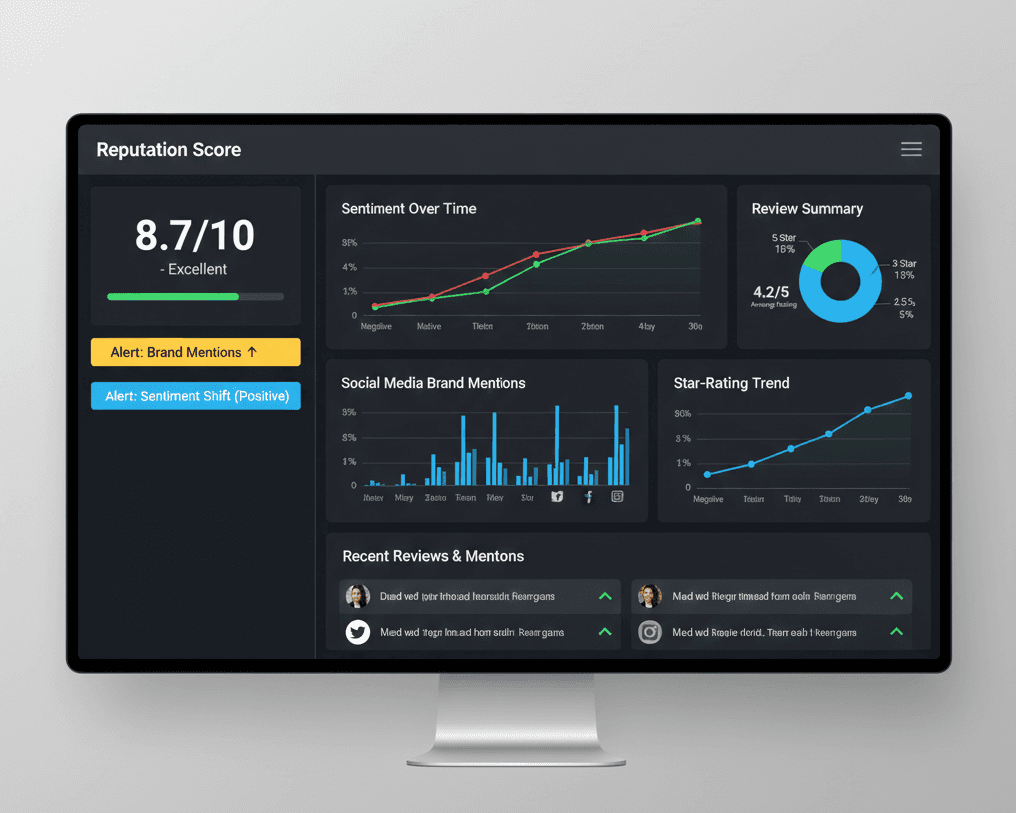
Brand reputation management refers to how your business monitors how your brand is perceived by customers and how to make it better. The “management” part refers to your strategy for improving your brand reputation.
A company’s online brand reputation management will include processes for:
Maintaining a consistent and positive image across all platforms.
Online feedback & sentiment analysis.
Engaging with customers.
The goal of brand reputation management is to maximize the positivity with which online users view your brand (or brands). A modern brand reputation management plan is centered around online reputation indicators like:
Reviews
Social media mentions
Search Engine Results
Brand reputation management is an ongoing process. As time goes on, you will find new opportunities, especially if you’re using the tips we’re about to go over. But you will inevitably also face challenges to your brand reputation and will have to adjust your responses to them.
Brand Reputation & Target Markets
Managing your brand reputation means comparing your brand’s values and messaging with the values of your target audience. Modern audiences can hold your brand to wildly different expectations. For example, pay attention to your target audiences’ demonstrated values regarding:
Affordability
Value
Health
Convenience
Robustness
Sustainability
A brand reputation can only be managed along the lines of your stated values and those of your customer demographics. So, market research always plays a role in forming a brand reputation that lasts. After that, there are many metrics of your brand reputation online.
Reputation Management vs Brand Reputation Management
Brand reputation management is the process of correcting and optimizing a specific brand’s reputation.
Reputation management is the correcting and optimizing of how your business as a whole is perceived.
Most small businesses can ignore this distinction after they have committed to a brand identity. With a business with one brand that is complete, these two terms are interchangeable. However, if your brand reputation isn’t creating a spark with your target markets, you can change your brand. This will restart the brand reputation management process, building up a new brand with different values and appearances.
Brand Reputation Management Framework
To build and sustain a strong brand reputation, businesses need more than isolated strategies. A structured framework ensures consistency, scalability, and measurable outcomes. Instead of reacting to feedback randomly, this approach allows organizations to proactively manage a brand reputation using defined processes and professional tools, which is central to effective brand and reputation management.
This framework is built on four core pillars: Monitoring, Response, Amplification, and Protection, forming the foundation of a scalable online brand reputation management strategy.
1. Monitoring: Track What People Say About Your Brand
Monitoring is the foundation of reputation management. Without visibility into customer sentiment, businesses cannot identify risks or opportunities.
Key actions:
Track brand mentions across search engines, review platforms, and social media
Monitor keywords related to your business and competitors
Set up real-time alerts for new reviews or mentions
Tools to consider: Using professional tools like review monitoring platforms and social listening tools allows you to centralize data and avoid missing critical feedback.
Example: A business that actively monitors Google reviews can quickly identify recurring complaints, such as delays in service, and address them before they escalate.
2. Response: Engage with Feedback Strategically
Once feedback is identified, timely and structured responses shape how your brand reputation is perceived.
Key actions:
Respond to all reviews, both positive and negative
Use consistent response frameworks to maintain tone and clarity
Resolve issues publicly when appropriate and move complex cases offline
Best practice: Respond within 24 hours to demonstrate accountability and active engagement.
Example: A brand that acknowledges negative feedback and provides a clear resolution path often converts dissatisfied customers into repeat buyers.
3. Amplification: Strengthen Positive Brand Signals
Amplification focuses on increasing the visibility of positive content to influence perception and search results.
Key actions:
Encourage satisfied customers to leave reviews
Showcase testimonials on your website and social channels
Publish high-quality content that reinforces your expertise
Tools to consider: Professional tools can automate review requests and display positive feedback using widgets or integrations.
Example: A company that consistently highlights positive customer experiences can improve trust and influence purchase decisions.
4. Protection: Safeguard Your Brand from Risks
Protection ensures that your brand reputation remains resilient during crises or negative events.
Key actions:
Develop a crisis management plan with clear communication protocols
Monitor sudden spikes in negative mentions
Secure customer data to maintain trust and compliance
Best practice: Prepare predefined response guidelines for high-risk scenarios to avoid delays or inconsistent messaging.
Example: A business that responds quickly and transparently during a service outage can reduce long-term reputational damage.
Comparison of Key Strategies to Manage a Brand Reputation
Strategy | Impact Level | Difficulty | Recommended Tools |
Review Management | High | Medium | Reviewshake |
Social Listening | High | Medium | Brand24 |
SEO Optimization | Very High | High | Ahrefs, SEMrush |
Content Marketing | High | Medium | Surfer SEO, Clearscope |
Customer Feedback Response | Very High | Low | Reviewshake, Broadly |
Crisis Management | Very High | High | Brand24, internal SOPs |
Community Engagement | Medium | Medium | Social platforms |
Competitor Monitoring | Medium | Medium | Brand24, SEMrush |
Data Security & Trust | High | High | Security tools, internal systems |
13 Brand Reputation Management Strategies
Your brand reputation management plan will require proactive strategies. Here are 14 actionable strategies that help you maintain a positive brand reputation.
1. How to Monitor Your Online Reputation Across Platforms
Your online presence includes every part of the internet where customers are exposed to your brand. A business’s online presence will normally include social media, review sites, and search engine results.
To make sure you’re monitoring your online presence:
Use Monitoring Tools: Leverage tools that provide live alerts for new brand mentions and reviews.
Track Review Sites: Follow reviews on Yelp, Google, Facebook, and other sites relevant to your industry.
Monitor Search Engine Results: Search your brand on search engines and review the top results for negative content.
Use Tools Like Reviewshake: Make sure you’re monitoring as much as possible and not missing any updates.
2. How to Respond to Customer Reviews and Feedback Effectively
After your customers leave feedback, your timing demonstrates a lot about your brand. Customers gauge your response times as a measure of how much you care. Faster responses to customer feedback enhance your brand’s reputation.
To ensure fast responses, use every alert system we listed above. Also, remember to keep your communication professional!
The key is that you need a plan for how to respond to negative reviews as well as positive ones. A plan, with a few templates, for each kind of review, makes it possible for you to respond faster.
3. How to Use Social Media to Strengthen Your Brand Reputation
Leverage social media to boost your brand’s reputation. A strong social media strategy can be a game-changer for your brand’s reputation. Social media provides you with many possibilities for positive (or negative) feedback.
To use social media to boost your brand reputation:
Share Content on Social Media: Connect with your audience on social media through visually appealing and interesting posts.
Engage With Followers: Respond to user comments to foster online communities around your brand.
Share Positive Reviews: Post testimonials and success stories to build trust with potential customers.
Utilize Influencers: Collaborate with influencers to amplify your brand’s reach and credibility.
Analyze Sentiment: Collect and aggregate data on how your brand is mentioned in social media comments.
4. How to Generate More Positive Reviews for Your Brand
Gather more positive reviews to enhance your brand’s online reputation. Positive reviews build trust and help offset negative comments, reviews, and articles.
To inspire positive reviews in a way that is practical:
Request Reviews After Purchase: Politely and promptly ask your happy customers to leave a review after a purchase or service.
Make Reviews Easy: Include direct links to your review pages in follow-up emails or on your website.
Offer Incentives: Consider offering discounts or rewards for honest reviews, but make sure you follow all platform rules.
Show Appreciation: Thank customers publicly and privately for their positive feedback.
5. How to Handle Negative Reviews Without Damaging Your Brand Reputation
You will need to address negative feedback to turn a dissatisfied customer into a loyal advocate. Experiencing at least some negative feedback is inevitable. You can put in place standard procedures for responding to them.
To respond to negative reviews tactfully, make sure you always:
Acknowledge the Issue: Always acknowledge and focus on the customer’s concerns directly.
Apologize: Apologize for the negative feelings your customer is experiencing. You should empathize with them unless you have strong reason to believe the review is fake.
Respond Promptly: Fast responses show that you value customer feedback and are committed to resolving issues.
Offer a Solution: Provide a clear plan or step to rectify the situation, without getting wrapped up in arguments or unrelated details.
6. How Content Marketing Improves Your Brand Reputation
Create a content plan to establish your brand as an authority in your industry. To build a better online brand reputation, remember to:
Publish Informative Blog Posts: Create posts that answer common questions, provide industry insights, or share valuable tips.
Customer Testimonials: Highlight positive reviews and case studies on your site and social media to build credibility.
Provide Insights: Distinguish your brand with thought leadership content that stands apart from what your competition offers.
7. How Community Engagement Builds Long-Term Brand Trust
Get your brand involved with community activities to increase your visibility and build customer relationships. To effectively engage with your community:
Sponsor Local Events: Sponsor local events and show support for your community, gaining exposure for your brand.
Participate in Charity Work: Involve your brand with charitable activities and donate to local causes to demonstrate your brand’s commitment to social responsibility.
Organize Community Events: Host events such as workshops, seminars, or fairs that can bring people together and add value to the community.
Volunteer Time and Resources: Get your brand and employees engaged with volunteer and community service opportunities.
8. How SEO Strategies Improve Your Online Brand Reputation
Integrate effective SEO strategies to improve your brand’s online visibility and build authority. The search engine optimization fundamentals for improving your online visibility include:
Keyword Research: All SEO decisions must start with research into the keywords relevant to your audience.
On-Page SEO: Optimize each of your webpage’s meta tags, headers, and URL structures.
Local SEO: Local SEO is especially important, so claim and optimize your Google My Business listing.
Backlink Building: Secure high-quality backlinks to boost your site’s authority and credibility.
9. How to Build a Consistent Brand Voice Through Internal Alignment
A strong brand reputation is not created through marketing alone. It is shaped at every customer interaction point, which makes internal alignment critical. Businesses that fail to standardize communication often create inconsistent experiences, especially across support, sales, and social channels.
To effectively manage a brand reputation, organizations need to ensure that employees understand not just what to say, but how to say it across different situations.
Key focus areas:
Unified communication guidelines
Create clear brand voice documentation that defines tone, response style, and messaging boundaries across platforms.Scenario-based training
Train teams using real-world situations such as handling negative reviews, responding to public complaints, or engaging with positive feedback.Response frameworks instead of scripts
Avoid rigid templates. Provide adaptable frameworks so responses remain consistent but not robotic.Cross-channel consistency
Ensure that messaging across email, social media, and review platforms reflects the same tone and positioning.
Using professional tools can support this process by centralizing responses, maintaining tone consistency, and tracking communication quality across teams.
10. Establish a Trust and Transparency Framework
Trust is a core driver of brand reputation, especially in industries where decisions are influenced by credibility and long-term relationships. Transparency is no longer optional. Customers, partners, and stakeholders expect clear communication during both stable and challenging periods. This is where structured brand and reputation management play a critical role in maintaining consistency and trust.
A structured framework ensures that trust is maintained even when issues arise and supports broader brand and reputation risk management efforts.
Core components:
Proactive communication strategy: Share updates on product changes, service issues, or company developments before they become concerns.
Clear ownership during crises: Define who communicates what, when, and through which channels to avoid confusion or delayed responses.
Public accountability: Address mistakes openly and outline corrective actions instead of avoiding or deflecting issues.
Consistent updates across channels: Ensure that messaging is aligned across website updates, social media, and customer communications.
Data-backed reporting: Use insights from professional tools to communicate performance, sentiment trends, and improvements to stakeholders.
Businesses that actively manage a brand reputation through transparency build stronger long-term trust and reduce the impact of negative events.
11. How to Build a Crisis Management Plan to Protect Your Brand Reputation
Every big brand faces at least one serious crisis. Your ability to respond swiftly and effectively determines a crisis’s long-term impact on your brand. To start implementing a strong crisis management plan:
Identify Potential Risks: Conduct a professional risk assessment to list and categorize possible threat scenarios for your brand’s reputation.
Build a Crisis Team: Assign a dedicated team with clear roles and responsibilities to manage public relations
Compartmentalize Crisis Management: Include specific plans for monitoring and responding on social media, review platforms, YouTube, and other places.
Develop Communication Protocols: Establish guidelines for how and when to communicate with stakeholders, customers, and the general public during a crisis.
12. How Competitor Analysis Strengthens Your Brand Reputation Strategy
Keeping an eye on your competitors can provide invaluable insights into your brand’s standing. You can find areas where you’re weak and find unique opportunities to set yourself apart. To effectively monitor your competitors:
Track Local Competitors: Use specialized tools to track competitors’ activities, such as marketing and customer engagement strategies.
Specific Keywords or Mentions: Monitor specific keywords or mentions of your competition to gauge public sentiment and spot opportunities for your brand.
Monitor Social Media and Review Sites: Monitor social media platforms and popular review sites like Facebook, Yelp, and Google.
Brand Visibility Score: Compare your brand visibility score with competitors to understand your market standing.
13. How Data Security Impacts Your Brand Reputation and Customer Trust
Cybersecurity is a top concern for consumers and company stakeholders. To keep up with privacy and compliance laws and safeguard sensitive information:
Implement Strong Security Measures: Use firewalls, encryption, and secure protocols to protect data from unauthorized access.
Regularly Update Software: Keep all software, including antivirus and anti-malware programs, up to date with regular patches and updates.
Conduct Regular Audits: Have periodic cybersecurity audits of your data protection strategies to identify and fix any weaknesses.
Limit Data Access: Restrict access to sensitive data with the principle of least privilege so employees can only access the data they need for their roles.
Common Brand Reputation Management Mistakes to Avoid
Managing a brand reputation is not only about execution. Small mistakes in handling feedback, communication, or reviews can reduce trust and visibility over time.
1. Ignoring Negative Reviews
Unanswered negative reviews signal inaction.
What happens:
Prospects see unresolved issues
Trust drops before engagement begins
Fix:
Respond within 12–24 hours
Address the concern directly
Offer a clear next step
2. Over-Automating Customer Responses
Automation without control leads to generic replies.
What happens:
Responses feel scripted
Customers disengage
Fix:
Use professional tools for alerts and tracking
Keep final responses human-reviewed
Adjust replies based on context
3. Incentivizing Reviews Without Compliance
Improper incentives violate platform guidelines.
What happens:
Reviews may be removed
Platform trust signals weaken
Fix:
Request feedback without conditions
Follow platform-specific policies
Focus on experience-driven reviews
4. Inconsistent Brand Tone Across Channels
Different tone across platforms creates confusion.
What happens:
Messaging feels disconnected
Brand identity weakens
Fix:
Define communication guidelines
Align support, social, and marketing responses
Review messaging periodically
5. Delayed Response to Feedback
Timing affects perception.
What happens:
Issues escalate
Negative sentiment spreads
Fix:
Set response benchmarks (under 24 hours)
Use professional tools to track incoming reviews
Prioritize critical feedback
6. Reactive Approach Only
Focusing only on damage control limits growth.
What happens:
Positive signals remain low
Negative content dominates search results
Fix:
Encourage consistent review generation
Publish content that supports trust
Maintain ongoing engagement
Step-by-Step Action Plan to Manage a Brand Reputation
Step 1: Audit Your Brand Mentions
Start by identifying where your brand appears online.
Focus areas:
Google search results
Review platforms
Social media mentions
This helps establish a baseline for your current brand reputation.
Step 2: Set Up Monitoring Systems
Use professional tools to track new mentions and reviews in real time.
What to set up:
Alerts for brand keywords
Review tracking dashboards
Social listening tools
This ensures you do not miss critical feedback.
Step 3: Build Response Frameworks
Create structured guidelines for responding to reviews.
Include:
Response tone and format
Templates for positive and negative feedback
Escalation paths for complex issues
This helps teams consistently manage a brand reputation across platforms.
Step 4: Launch Review Generation Campaigns
Encourage satisfied customers to leave reviews.
Approach:
Request feedback after service or purchase
Use email or SMS follow-ups
Make the review process simple
This strengthens positive signals linked to your brand reputation.
Step 5: Optimize Search Visibility
Improve how your brand appears in search results.
Actions:
Publish relevant content
Optimize key pages
Build high-quality backlinks
This ensures positive content ranks higher than negative mentions.
Step 6: Monitor, Analyze, and Adjust
Reputation management is ongoing.
Track:
Review trends
Response times
Sentiment changes
Use insights from professional tools to refine your strategy and maintain long-term consistency.
Top Tools to Boost Your Brand’s Reputation Management Strategy

Implementing a brand management strategy on your own is no longer practical. To apply these best practices efficiently and at scale, businesses often rely on brand reputation management tools that streamline monitoring and response.
From review tracking to sentiment analysis, these solutions support online brand reputation management by giving you a clear view of how your brand is perceived across platforms. With access to centralized data and insights, teams can make informed decisions and maintain a strong, consistent brand presence.
1. Reviewshake
Reviewshake is an all-in-one reputation management platform designed to centralize review monitoring, automate feedback collection, and provide actionable insights. It allows businesses to track customer sentiment across multiple platforms while maintaining consistent engagement.
Key Capabilities:
Centralized dashboard to monitor reviews across multiple platforms
Automated review requests via email and SMS
Sentiment analysis to identify trends in customer feedback
Widgets and integrations to showcase positive reviews
Pricing:
Reviewshake offers tiered pricing based on business needs:
Individual plan: $79 per month
Professional plan: $139 per month
Business plan: $179 per month
A 14-day free trial is typically available for users who want to evaluate the platform before committing.
2. Broadly
Broadly is a reputation management and customer communication platform designed for small to medium-sized businesses. It focuses on simplifying review collection and customer engagement through automation.
Key Capabilities:
Automated review requests via SMS and email
Customer messaging and communication tools
Review monitoring across multiple platforms
Website integrations to display customer feedback
Pricing:
Broadly offers tiered pricing plans:
Standard: $249 per month
Pro: $349 per month
Elite: $449 per month
Enterprise pricing varies based on business requirements.
3. Brand24
Brand24 is a social listening and online monitoring tool that tracks brand mentions across social media, news sites, blogs, and forums. It helps businesses understand public sentiment and respond to conversations in real time.
Key Capabilities:
Real-time monitoring of brand mentions across multiple channels
Sentiment analysis to evaluate positive, negative, and neutral feedback
Influencer identification and trend tracking
Custom alerts for keywords and brand-related discussions
Pricing:
Brand24 offers multiple pricing tiers:
Individual: $79 per month
Team: $149 per month
Pro: $199 per month
Enterprise: $399 per month
A 14-day free trial is available for new users.
4. Reputology
Reputology is a reputation management tool focused on review monitoring, especially for businesses with multiple locations. It centralizes customer feedback from various platforms into a single dashboard for easier management.
Key Capabilities:
Multi-location review monitoring across platforms
Centralized dashboard for tracking feedback
Automated response templates for consistency
Integration with platforms like Google, Yelp, and Facebook
Pricing:
Reputology pricing varies based on the number of locations:
Single location: $29 to $49 per month
Multi-location plans: $10 to $49 per location per month
Custom pricing may apply for larger businesses or agencies.
Maintain a Positive Brand Reputation With Reviewshake
Forget just maintaining a good reputation – unlock a stellar one with Reviewshake. This powerful all-in-one platform equips you to take complete control of your brand narrative.
Reviewshake offers a comprehensive solution to help you manage your brand reputation effectively. With Reviewshake, you can:
Centralize Review Management: Monitor and manage reviews from over 100 platforms in one convenient dashboard, ensuring you stay on top of all feedback.
Automate Review Requests: Send personalized review requests via email and SMS to encourage more customers to leave positive reviews.
Showcase Positive Reviews: Highlight your best reviews on your website and social media using widgets and Rich Snippets, boosting your brand’s credibility and visibility.
Leverage Advanced Analytics: Gain insights into review performance, conduct sentiment analysis, and benchmark against competitors to make informed decisions.
Ready to take control of your brand’s reputation? Try Reviewshake for free today and discover how our platform can help you manage and improve your brand’s image effectively.
FAQs on Brand Reputation Management
Q1: What is brand reputation management?
It refers to the process of monitoring, influencing, and improving how a business is perceived online. It includes tracking reviews, responding to feedback, managing search results, and using brand reputation management tools to analyze sentiment. The goal is to maintain a consistent and positive brand reputation across digital platforms as part of a broader online brand reputation management strategy.
Q2: How do you fix a bad online reputation?
To fix a negative reputation, identify recurring issues, respond to feedback with clear resolutions, and generate positive reviews consistently. Improving search visibility and addressing customer concerns are key. Businesses that invest in brand reputation management services and structured brand and reputation management strategies can gradually shift perception and rebuild trust over time.
Q3: Which tools are best for reputation management?
Common tools include review monitoring platforms, social listening tools, and SEO software. These solutions fall under brand reputation management software and are essential for tracking mentions, managing reviews, and analyzing sentiment. Many businesses rely on brand reputation management tools like Reviewshake and Brand24 to centralize data and improve response efficiency.
Q4: How long does it take to improve brand reputation?
The timeline depends on the severity of the issue and the consistency of actions. Minor issues may improve within weeks, while more complex cases take several months. Strong execution of online brand reputation management, combined with consistent monitoring and response systems, plays a major role in accelerating results. In some cases, reviewing brand reputation management case studies can provide realistic timelines and expectations.
Q5: Why is brand reputation important for SEO?
Search engines consider trust signals such as reviews, ratings, and engagement when ranking businesses. A strong brand reputation improves click-through rates and visibility in search results. Consistent feedback management, supported by brand and reputation risk management practices, ensures long-term stability. During critical situations, effective crisis management can prevent negative content from dominating search results and impacting rankings.