7 Reasons Online Review Monitoring Is Essential for Brand Growth
Customers do not walk into a business blind anymore. Before spending a single dollar, most people pull out their phones and check reviews. Research shows that over 90% of consumers read online reviews before making a purchase decision. That habit has completely changed how brands need to operate.
Reviews also directly affect how well your business ranks in local search results. Google pays close attention to review signals, including volume, recency, and how often businesses respond. A brand with 200 reviews and active responses will consistently outrank a competitor sitting on outdated, unanswered feedback.
The old approach of manually checking Google or Yelp a few times a week does not work at scale. A multi-location brand might have hundreds of new reviews landing every day across dozens of platforms. You simply cannot catch them all by hand, and missed reviews mean missed chances to fix problems, win back customers, and improve your product.
Every unread negative review is a potential lost sale. Every unanswered complaint is a customer who might share that frustration with their entire social network. Online review monitoring is not a nice-to-have feature anymore. It is the backbone of any serious brand growth strategy.
What Is Online Review Monitoring?
Online review monitoring means tracking what customers are saying about your brand across all the major review platforms in real time. That includes Google, Yelp, Facebook, TripAdvisor, G2, Trustpilot, Booking.com, and dozens of other sites depending on your industry.
Google review monitoring gets the most attention because Google reviews carry the most weight in local SEO and because Google is where the majority of consumer searches happen. But limiting your monitoring to Google alone leaves major blind spots. A brand with a 4.8-star Google rating can still have a 2.9-star rating on a niche review site that your specific target audience trusts deeply.
It is also worth separating monitoring from responding. Monitoring means staying aware of what is being said. Responding is the action you take once you know. Both matter enormously, but you cannot respond well to reviews you have not seen yet. Strong monitoring creates the foundation that makes fast, effective responses possible.
Reason 1: Protect Your Brand Reputation in Real Time
A negative review that sits unanswered for a week does far more damage than one that gets a thoughtful response within hours. Online reputation monitoring tools send instant alerts the moment a new review lands, regardless of which platform it appears on. That speed gives your team a fighting chance to address problems before they spiral.
One scathing one-star review, left alone, can influence dozens of prospective customers who read it in the days before anyone notices it. With real-time alerts, you can respond quickly, acknowledge the issue, and show everyone reading that thread exactly how your brand handles adversity.
Review monitoring also helps you spot fake reviews early. Competitors sometimes leave fraudulent negative reviews to drag down your rating. Catching these fast and flagging them for removal keeps your overall score accurate and your reputation intact.
Reason 2: Improve Customer Trust and Credibility
Customers are not just reading your star rating. They are reading how you respond to reviews. A brand that replies to negative feedback professionally and resolves issues openly signals to every future customer that their experience will be taken seriously. That kind of transparency converts better than any ad campaign.
Responding to positive reviews matters just as much. When someone takes the time to leave a glowing five-star review and gets zero acknowledgment from the brand, it feels like a missed handshake. A short, genuine reply reinforces the relationship and encourages that customer to come back.
Brands that actively monitor and respond to customer reviews across platforms build a visible track record of accountability. That track record increases conversion rates on your Google Business Profile, your website, and any third-party listing where potential customers compare you to competitors.
Reason 3: Boost Local SEO Rankings
Google's local ranking algorithm factors in review signals heavily. The total number of reviews, the recency of reviews, the diversity of review content, and your response rate all influence where you appear in local search results and the coveted local pack.
Google review monitoring keeps you on top of your review activity so you can respond consistently and encourage ongoing review generation. Businesses that respond to reviews consistently tend to rank higher than those that let reviews pile up without engagement.
Fresh reviews are also a ranking signal. A business that received 50 reviews two years ago and nothing since is sending a stale signal. Active monitoring helps you identify when review velocity is dropping so you can proactively encourage new feedback before your local rankings take a hit.
Reason 4: Respond Faster Than Competitors
Speed is an underrated competitive advantage in review management. When a frustrated customer leaves a one-star review, they are often still emotionally invested in getting a resolution. A brand that responds within an hour has a realistic shot at recovering that customer. A brand that responds four days later is almost certainly too late.
Most businesses are not monitoring reviews in real time. The average response time across industries is measured in days, not hours. That gap is a genuine opportunity. If your brand can consistently respond faster than the competition, you will win more customers back and reduce churn at a measurable rate.
Review management software with automated alerts removes the delay entirely. Your team gets notified the moment a new review goes live, which means response time drops dramatically without requiring anyone to manually check a dozen platforms every morning.
Reason 5: Identify Operational Issues Early
Reviews are real-time operational feedback. When three different customers in the same week mention that wait times at your Dallas location have gotten worse, that is not coincidence. That is actionable data pointing at a staffing or scheduling problem that your internal systems might not have flagged yet.
Tracking trends across locations with online reputation monitoring tools lets you see patterns that would otherwise stay invisible. One complaint is an outlier. Ten complaints about the same thing over 30 days is a systemic problem that needs fixing immediately.
Brands that use review data this way end up ahead of their competition because they are fixing real problems, not guessing. Customer feedback is often more honest and specific than internal surveys, and it arrives faster than most traditional feedback channels.
Reason 6: Manage Multi-Location Businesses Efficiently
Running a 20-location restaurant chain or a franchise network without centralized review monitoring is an operational nightmare. Each location generates its own reviews across multiple platforms, and without a single dashboard pulling everything together, things fall through the cracks constantly.
Review management software solves this by letting you monitor customer reviews across platforms from one place. You can see at a glance which locations are trending down, which are getting great feedback, and where response rates are lagging. That visibility lets management act quickly instead of waiting for weekly reports.
Standardizing response workflows across locations is another major benefit. When every team member follows the same process for responding to reviews, brand tone stays consistent and no customer falls through the cracks. Comparing location performance through a centralized dashboard also creates healthy internal accountability.
Reason 7: Turn Reviews Into Revenue Opportunities
Positive reviews are marketing assets. A five-star review praising your customer service or a specific product feature can be repurposed as a testimonial on your website, in email campaigns, or as social proof in paid ads. Brands that actively monitor their reviews never run short of fresh content for this.
Reviews also surface upsell opportunities. When a happy customer mentions they wish a specific product came in more sizes, or that they would love a loyalty program, that is direct market research you are getting for free. Acting on those signals can drive real revenue growth.
Monitoring reviews also helps you identify your most loyal advocates. Customers who consistently leave positive reviews are candidates for referral programs, ambassador relationships, or targeted retention campaigns. That group is cheaper to keep and more likely to generate word-of-mouth than any cold audience.
How Review Monitoring Tools Make This Easier
Manual tracking across 10+ platforms is not sustainable. Review monitoring tools automate the hard parts so your team can focus on the work that actually requires human judgment, like crafting genuine responses and acting on customer insights.
The features that make the biggest difference in day-to-day operations include:
Automated alerts that notify your team the moment a new review lands, regardless of platform
Sentiment analysis that categorizes feedback by tone so you can prioritize urgent responses
AI-powered response suggestions that save time without sacrificing personalization
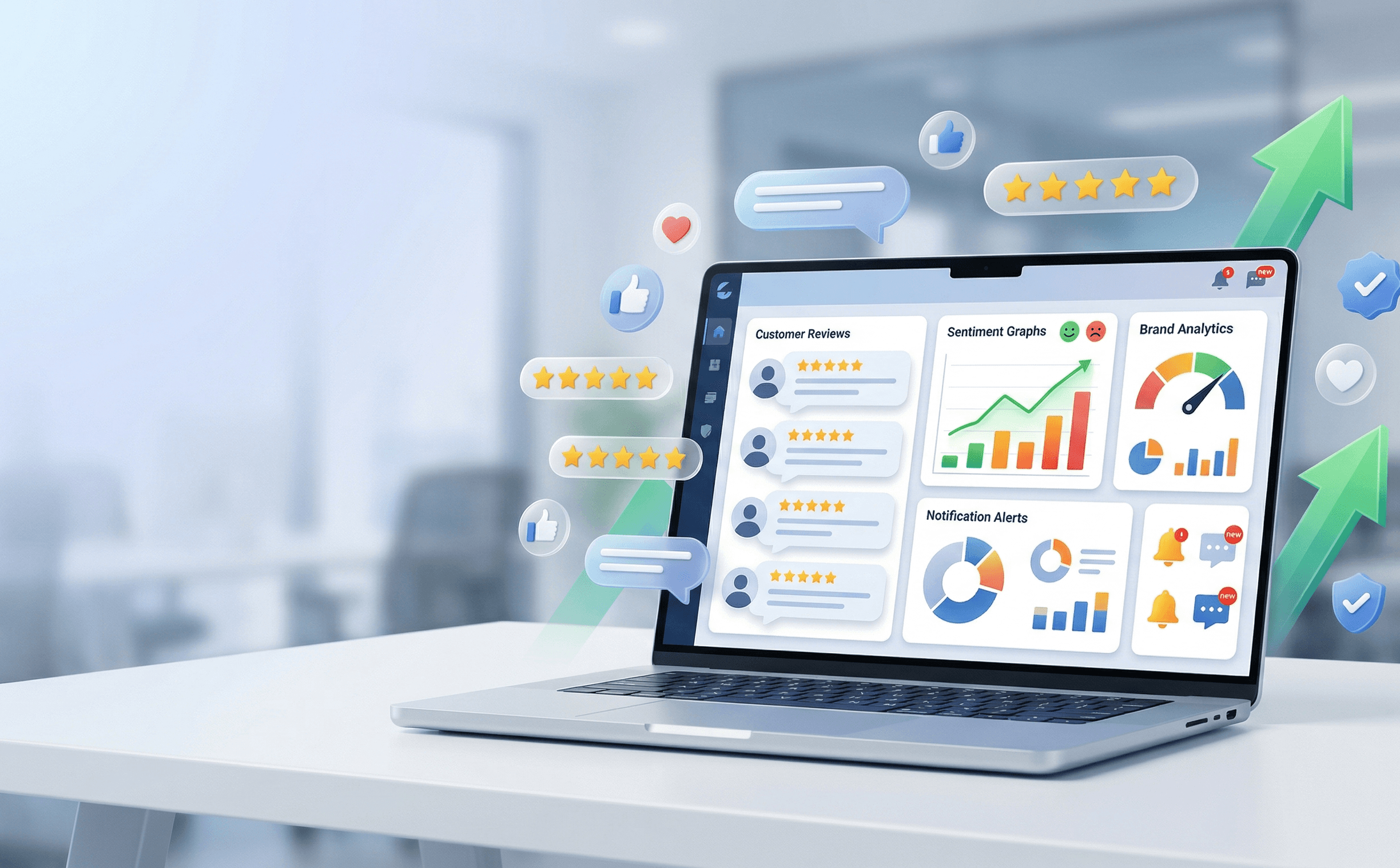
Reporting dashboards that track trends, response rates, and star rating changes over time
Integrations with platforms like Google, Yelp, Facebook, TripAdvisor, and industry-specific sites
Review management software gives you the kind of oversight that is simply impossible to replicate manually. The difference between checking reviews twice a week and monitoring them in real time is not just a matter of convenience. It has a direct impact on customer retention, SEO rankings, and brand perception.
Common Mistakes Businesses Make With Review Monitoring
Checking reviews manually once a week is the most common mistake, and it puts brands at a consistent disadvantage. A negative review that sits unanswered for seven days has already influenced dozens of potential customers by the time anyone sees it.
Many brands make the mistake of monitoring only Google. That focus is understandable given Google's dominance, but it leaves platforms like Yelp, Facebook, and industry-specific sites completely unattended. Depending on your business type, those platforms might matter more to your specific customers than Google does.
Not responding to positive reviews is a missed opportunity that most brands overlook. A quick, genuine reply to a glowing review reinforces the customer relationship and signals to everyone else reading that your brand is engaged and human.
Neutral three-star reviews often get ignored entirely. A customer who leaves three stars is not happy enough to come back without intervention, but they are not angry enough to warn others away. That middle group is actually one of the best recovery opportunities your team has, and most businesses miss it completely.
Having no response workflow is the operational mistake that compounds all the others. Without a clear process for who responds, when, and in what tone, review management stays inconsistent and reactive. Standardizing that workflow is one of the highest-return improvements any brand can make.
Monitor, Respond, Improve, Grow
Online review monitoring is the engine behind every other part of your reputation strategy. You cannot respond well to reviews you have not seen. You cannot fix operational problems that reviews expose if you are not reading them. You cannot turn positive feedback into marketing gold if it disappears into the noise of 12 different platforms.
The brands that grow consistently are the ones that take customer feedback seriously, respond to it fast, use it to improve their operations, and share their best reviews with the world. That cycle starts with monitoring.
Reviewshake's review monitoring tools let you track every review across all major platforms from a single dashboard, respond faster with AI-powered suggestions, and build a brand reputation that drives real growth. Start monitoring smarter today.
Frequently Asked Questions About Online Review Monitoring
What is online review monitoring?
Online review monitoring is the process of tracking and managing customer reviews posted about your business across multiple review platforms in real time. It includes receiving alerts for new reviews, analyzing sentiment trends, and identifying opportunities to respond and improve customer experience.
Why is monitoring online reviews important for businesses?
Monitoring online reviews is important because reviews directly influence purchasing decisions, local SEO rankings, and brand credibility. Without active monitoring, businesses miss negative feedback before it escalates, lose opportunities to recover unhappy customers, and fall behind competitors who respond faster and more consistently.
What are the best tools for online review monitoring?
The best review monitoring tools offer multi-platform coverage, real-time alerts, sentiment analysis, AI-powered response suggestions, and centralized dashboards for managing multiple locations. Platforms like Reviewshake bring all of these capabilities together so brands can track and respond to reviews at scale without switching between tools.
How do I monitor Google reviews for my business?
You can monitor Google reviews manually through your Google Business Profile, but this only covers Google and requires regular manual checks. Review management software automates Google review monitoring by pulling new reviews into a single dashboard the moment they go live, sending instant alerts, and allowing you to respond directly from the platform without logging into Google separately.
How does review monitoring help with SEO?
Review monitoring helps SEO by keeping you on top of your review activity so you can respond consistently, maintain review recency, and increase your overall response rate. All of these are factors Google's local search algorithm considers when ranking businesses in local pack results. Active monitoring leads to better review signals, which leads to higher visibility.
Can I monitor reviews across multiple platforms at once?
Yes. Review management software is specifically designed to monitor customer reviews across platforms including Google, Yelp, Facebook, TripAdvisor, Trustpilot, G2, and many others from a single dashboard. This multi-platform monitoring eliminates blind spots and ensures no review on any platform goes unnoticed.
How often should I check and respond to online reviews?
Ideally, you should respond to reviews within 24 hours, and for negative reviews, within a few hours if possible. The faster you respond, the higher your chances of recovering unhappy customers and the stronger the signal you send to potential buyers. Real-time monitoring tools make this achievable without requiring someone to manually check every platform multiple times per day.